



Traditional 5-a-Side Goal Buying Guide
Why are there so many different sizes of 5v5 and 5-a-side goal?
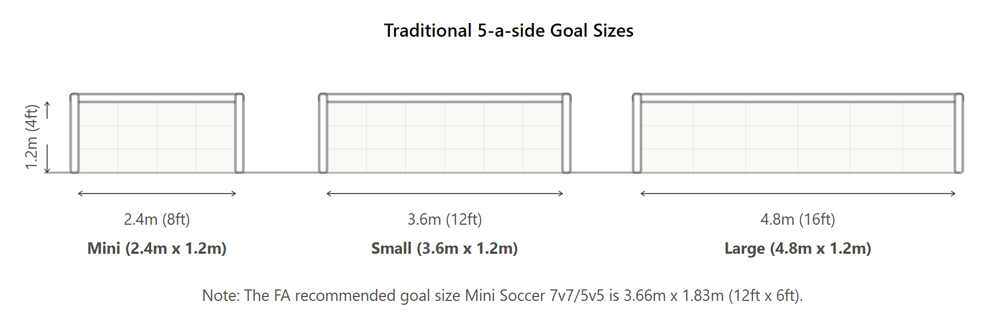
It's complicated! In the past, 5-a-side goals were usually 2.4m, 3.6m or 4.8m wide (8ft, 12ft or 16ft) and 1.2m (4ft) high.
However today, The Football Association encourages use of 3.66m x 1.83m (12ft x 6ft) goals for both 7v7 and 5v5 football. We usually refer to these as Mini Soccer 7v7/5v5 goals.
In practice though, many leagues, clubs and sports halls continue to use the previous 1.2m high goals. Besides the expense of replacing perfectly functional equipment, many venues or leagues apply a head-height rule to games meaning that a 1.8m tall goal is unnecessarily large and the original 1.2m high goals actually suit the format better.
So whilst not a recommended FA goal size, 1.2m high goals remain popular for 5-a-side football. We refer to these 1.2m high goals as "Traditional" 5-a-side goals.
But that's not quite the end of it.
The Scottish Football Association specifies a different size: 4.88m x 1.83m (16ft x 6ft) for 9v9, 7v7 and 5v5 football.
For 4v4 football, the Scottish FA specifies a maximum 2.4m x 1.2m (8ft x 4ft) goals, which is one of the previous "Traditional" 5-a-side sizes.
The Football Association of Wales (FAW) recommends 2.4m x 1.2m (8ft x 4ft) goals for 5v5 football.
The Irish Football Association (IFA) recommends 3.6m x 1.2m (12ft x 4ft) goals for 5v5.
In short, if you're buying goals for an organised league, always check the league's preferred size before ordering.
Which size of "Traditional" 5-a-side goal is right for my setting?
The 2.4m x 1.2m (8ft x 4ft) goal is the smallest of the three sizes. These are sometimes called 'mini' 5-a-side goals. These also work well as training goals, in confined spaces, or for younger juniors where a narrower goal suits the age group. It's not the (English) FA's recommended size for any specific junior format - that's 3.66m x 1.83m (12ft x 6ft) for 7v7/5v5 - but it's a popular recreational and practice option. This size is still recommended for 5v5 football by the Football Association of Wales, and by the Scottish FA for 4v4 football.
The 3.6m x 1.2m (12ft x 4ft) goal is the most popular size in the UK for recreational 5-a-side. It's widely used in sports centres, school halls, and on outdoor 3G and grass pitches, and is the size most clubs and leagues default to when no specific size is mandated. In Northern Ireland, this is also still the recommended size for 5v5 football.
The 4.8m x 1.2m (16ft x 4ft) goal is the widest of the three, used in larger indoor venues and outdoor pitches where more space is available. Adult leagues running on full-width pitches often prefer this size for a more open game.
Remember, if you're purchasing goals for a junior 5v5 league affiliated with The FA / England Football, bear in mind that the recommended goal size is 3.66m x 1.83m (12ft x 6ft). Those goals are taller than "Traditional" 5-a-side goals.
What's the difference between steel and aluminium goals?
Steel goals are heavier and provide a sturdy option for high-use environments. Whilst steel goals are usually galvanised and/or powder coated to extend their outdoor lifespan, they can rust if the surface coating is damaged and left untreated. Steel goals are usually cheaper than aluminium alternatives.
Aluminium goals are lighter and naturally rust-resistant, making them easier to move between sessions and a better choice for goals that need to be stored away regularly. They cost more than equivalent steel options, but the weight saving, ease of use and lower maintenance requirement often justify the difference for busy clubs and schools.
What is a Portagoal, and do I need one?
Simply put, an easy to move football goal. This type of goal may have wheels, a rolling backbar or even feature 360 degree rotating balls to facilitate movement across a pitch.
If you'll be moving your goals frequently, consider some kind of portagoal to make life easier.
What is an integral weighted or self weighted goal?
Integral weighting means that a goal has the counterbalance needed to keep the goal stable built into the frame itself, rather than requiring separate 'handbag' style weights or ground pegs. Harrod Sport's 4G Weighted Portagoals are the most advanced version of this design - they roll easily into position and require no additional anchorage. They're the premium option, but they're genuinely useful on 3G and artificial surfaces where keeping sufficient counterbalance weights or using chain anchors is impractical.
If your goals will always stay in one place, consider using socketed goals instead - although these will require ground installation there won't be any anchorage requirements. If the goals will only be moved occasionally, a standard freestanding goal with suitable anchors would usually be the more cost-effective choice. If the goal is likely to be moved quite frequently, integral weighted goals are the best choice.
What about fence-folding goals?
Fence-folding goals are permanently attached to the perimeter fence of a pitch. When not in use they fold flat against the fence, keeping the pitch clear. This is a convenient choice for Multi-Use Games Areas (MUGAs) and synthetic pitches where storage space can be limited and the goals need to be ready to use quickly. They require the pitch to have a suitable perimeter fence, and the projection depth (the distance from fence to crossbar when deployed) needs to match the pitch layout - we offer 3.6m goals in two projection options (2.3m–3.5m and 3.5m–5.0m).
It's important to note that this type of goal is very difficult to install and must be done by a specialist installer - ideally at the same time as the MUGA.
Can you tell me more about anchoring?
On grass, U-pegs (AN100 or ANC-606) are the simplest option, driven into the ground at the base of the goal. For harder or sandier ground, earthworm screw anchors (AN400) give a more secure fixing.
On artificial or 3G surfaces, 'handbag' counterweights (AN900) are a popular solution. Fence anchor chains (ANC-022) are an alternative where a perimeter fence is available, attaching the goal directly to the fence structure with a chain and clips.
For indoor use, sports hall counterbalance 'handbag' weights (ANC-009) include a rubber base to prevent damage to sports hall flooring. Wall or floor anchors can also be used, should fixing points be available.
Self-weighted goals require no additional anchorage - the integral weight built into the frame of the goal handles stability without extra equipment.
Remember: Unanchored freestanding goals can be dangerous due to a tipping risk. Every freestanding goal must be secured properly before, during and after use. Goals should never be left unsecured when stored or unattended.
Which net should I choose?
Nets are usually sold separately from goals (unless buying a goal pack, in which case they're included). All our "Traditional" 5-a-side nets use 100mm mesh. The key choice is twine thickness: 2.5mm nets are the entry-level option, suitable for light or occasional use; 3mm nets are the most popular choice for regular club use; 4mm braided nets are the most durable and are worth the extra cost for goals that see daily or heavy use. Nets must be sized to fit the specific goal frame, so check the product description carefully. Eg, a net listed as fitting 3.66m goals will not fit a 4.88m frame.
Are goal packs worth it?
Yes! Goal packs bundle the goals, nets, and sometimes anchors together at a combined price cheaper than buying each component separately. If you know which goal you want and will need nets regardless, a pack is always the better value option. However, we appreciate that some clubs may have suitable nets, net supports or anchors already, so the individual items in each goal pack are all available separately too - allowing you to buy only the parts required.
Have a question?
Buying football goals can be complicated. Whilst we've tried to categorise sizes and types in various different ways on our website to make buying as easy as possible, we know it's sometimes better to speak to a real person. So feel free to give us a ring on 01858 545789 or email [email protected] if you have any questions.