



Netball Court Guide

Understanding the layout of a netball court is essential before specifying posts, floodlights, or any other permanent fixtures.
Whether you're marking out a new court, installing socketed posts, or adding floodlights to an existing facility, getting the layout right from the start saves considerable time and expense later. The guide below covers court and zone dimensions, goal post positioning, socket installation considerations, and floodlighting options.
What are the different zones on a netball court?
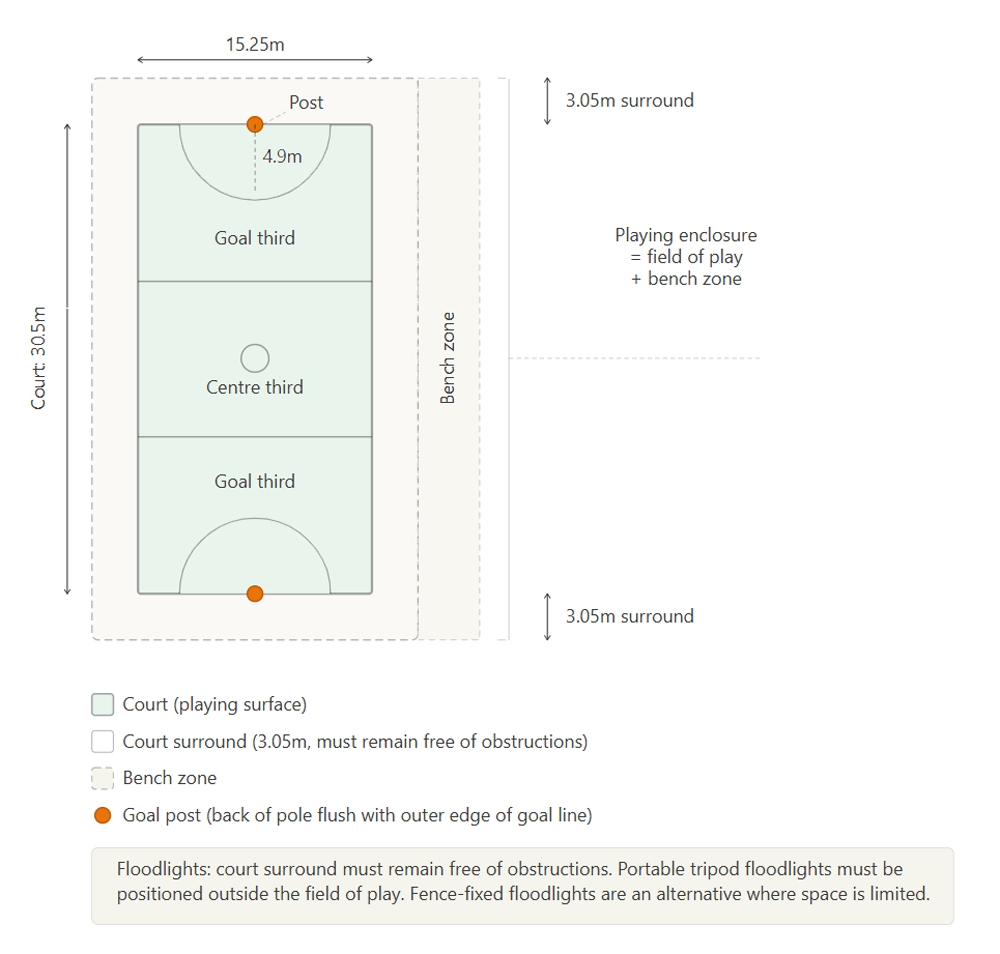
A netball court has several distinct zones, each with a specific purpose:
The court itself is the rectangular playing surface, measuring 30.5m long and 15.25m wide (100 ft by 50 ft). It's divided into thirds (the centre third and the two goal thirds). The centre third has a centre circle 0.9m in diameter (3 ft) in the middle. A goal circle (which is actually a semi-circle) with a 4.9m (16 ft) radius is located at each end.
A run-off area, known as the court surround wraps around the court on all four sides. It must extend at least 3.05m (10 ft) from all sidelines and goal lines, bringing the total field of play to 36.6m long by 21.35m wide. This court surround area must be kept completely clear of obstructions during play (no benches, bags, equipment, floodlights etc) and spectators must stay outside of this area.
The field of play is the court plus its surround. During play, only the on-court players and umpires are permitted in the field of play.
The bench zone sits immediately alongside the field of play, on one side of the court. The official bench, umpires' bench, and team benches are all located here. Together, the field of play and the bench zone form the playing enclosure.
Where should netball posts be positioned?
Post positioning is one of the more commonly misunderstood aspects of court setup. A netball post is placed at the midpoint of each goal line, so that the back of the pole sits at the outer edge of the goal line. The post is not placed in front of, or behind, the goal line - the back edge is flush with it.
For freestanding posts on a weighted base, the base should be positioned so it doesn't obstruct play in the goal circle area or create a trip hazard. The bases should be placed so that they extend behind the goal line into the court surround. Use of freestanding posts is acceptable for training and recreational use, but socketed posts should be used for competitive matches.
For socketed posts, the upright should be positioned at the midpoint of the goal line, with the back face of the post flush with its outer edge. Getting this right during installation is very important - once sockets are set into a concrete surface, they're difficult to correct! For indoor sports halls, we'd recommend that sockets are installed at the same time as the flooring.
What do I need to consider when installing ground/floor sockets for socketed posts?
Planning ahead is essential, since sockets are a permanent fixture once installed. A few points worth considering before work begins:
The socket must be positioned precisely. As above, the back of the installed post needs to sit at the outer edge of the goal line, at the midpoint of the goal line's length. If your court is being marked at the same time as sockets are installed, agree on the line positions before any concrete is poured. For indoor sports halls, installing sockets at the same time as the flooring is usually recommended, as retro-fitting sockets into existing flooring can be tricky.
After posts have been inserted into ground sockets, they should have minimal movement and remain stable if/when knocked. This means the socket depth and construction method matters - a shallow or poorly anchored socket will allow the post to rock, which is a safety issue. Always follow the manufacturer's installation instructions for the specific post model.
Can I install floodlights on a netball court?
Yes, but placement is restricted by the court surround rules. Since the surround must remain free of obstructions, floodlights on tripod stands cannot be positioned within the 3.05m surround zone. This leaves two practical options:
Portable tripod floodlights can be used, but must be positioned outside the field of play entirely - beyond the 3.05m surround. This works well where there is sufficient space around the court, such as on an open MUGA or a grass area. They should never be positioned anywhere that may cause a trip hazard.
Where space is tighter, fence-fixed floodlights are a practical alternative. Mounted onto a perimeter fence, they illuminate the court without placing any obstruction at ground level. Our netball court floodlights include both portable and fence-fixed options, with battery-powered LEDs giving up to four hours of use per charge.