



Table Tennis Table Buying Guide
Does my table tennis table need to be ITTF Approved?
Unless you’re competing at elite levels or providing tables for use in a high level competition, then probably not. Only tables independently tested for dimensional accuracy and bounce uniformity can carry the official ITTF stamp. So it's worth knowing what that stamp does and doesn't mean for you.
ITTF Approval is a prerequisite for a table being used in international competition, but it isn't required outside of these events. You'll mainly find ITTF-Approved tables in dedicated clubs and at tournaments, where the certification confirms a level of craftsmanship and consistency needed for elite play. For schools, leisure centres, clubs running domestic leagues, or home use, it’s not as important.
Relatively few tables carry this certification, since the additional testing and ongoing costs involved mean most manufacturers don't pursue it unless a table is genuinely intended for international competition. A table can still be built to full regulation dimensions, use the same materials and construction methods, and play exactly the same as a certified one - it just hasn't been through (or paid for) the formal ITTF testing process. All of our Butterfly tables are built to regulation size, but only the Butterfly Space Saver Rollaway 25 carries official ITTF approval.
What are the regulation sizes for table tennis tables?
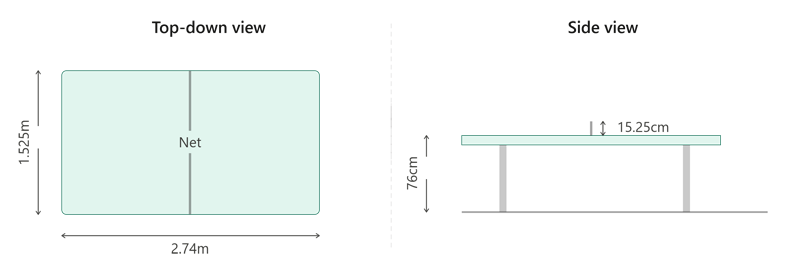
ITTF Regulations state the top of the playing surface of a table tennis table should be:
2.74m long
1.525m wide
76cm high
The net divides the table into two equal halves, standing 15.25cm high across the playing surface.
These dimensions are the size of all of the tables offered by sportsequip (indoor or outdoor).
What about the table thickness?
Thickness is one of the clearest indicators of quality, even though it isn’t dictated by any formal rule. There's no official minimum or maximum thickness for a table tennis top - the only requirement is that it produces a consistent bounce. In practice, though, thicker tops tend to perform more reliably match after match.
International tournaments are typically played on tables around 25mm thick, and this is generally where you'll see the most consistent bounce across the whole surface, with less flex under impact. Thinner tops, often found on budget and rollaway tables, can still play well, but they're more prone to slight variation in bounce towards the edges, and tend to feel less solid during fast rallies.
A thicker top also tends to last longer under regular use, particularly in busy environments like schools or clubs where a table might see dozens of games a day. If you're buying for serious or frequent play, it's worth treating thickness as one of the first specs to check, alongside the frame and leg construction.
How much space do I need?
Getting the table itself into a room is usually the easy part. Allowing enough space for people to move around it is more of a problem!
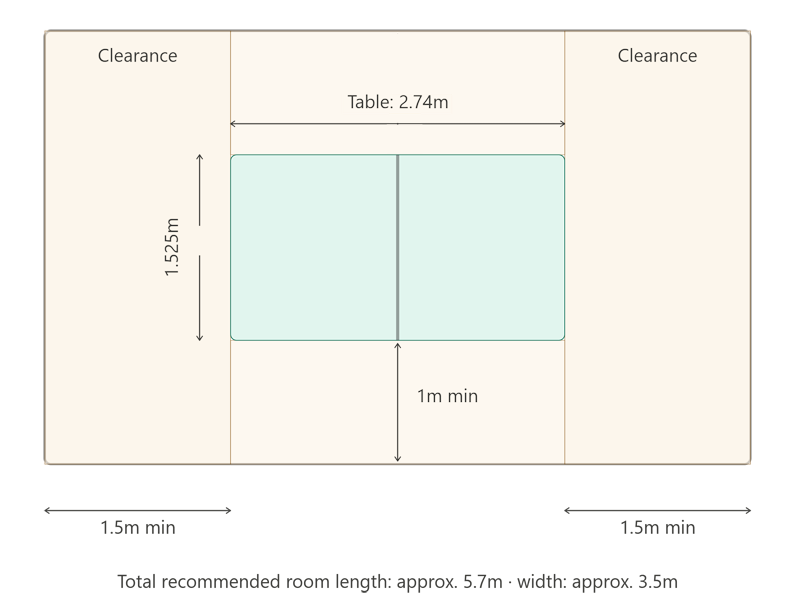
As a practical baseline, allow at least 1.5 metres of clearance behind each end of the table. Players need this room not just to stand, but to step back for defensive returns, retreat for power shots, and follow through without clattering into a wall or furniture. Side clearance matters too, though slightly less - most rallies happen along the length of the table rather than across it, so 1m or so down each side is usually enough for a home or club setting.
Put together, a comfortable space for a single table works out at roughly 5.7m long by 3.5m wide, once you add that clearance to the table's own footprint. Smaller rooms can still work for casual play, but expect shots to be cut short and players to feel cramped during faster rallies.
Accessibility: If the table needs to be wheelchair accessible, leg position matters as much as floor space. A 400mm distance between the end of the table and the first leg is the figure used to meet Paralympic accessibility requirements, allowing a wheelchair user to get close enough to the table without the leg getting in the way. If you're buying for a school, club, or public space with accessibility needs, the Butterfly Space Saver Rollaway 25 Table Tennis Table meets this requirement.
About our All-Weather / Concrete Outdoor Table Tennis Tables...
Our range of outdoor table tennis tables are significantly different from the indoor tables. As well as being designed for outdoor use (of course) they’re meant to be fixed permanently to the floor/ground. These tables weigh, especially in the case of the concrete models, significantly more than indoor tables.
Prior to ordering these models, it’s worth speaking to our sales team as there are special delivery requirements which should be considered. You can also read more about the delivery requirements here:
https://www.sportsequip.co.uk/delivery-requirements-for-concrete-table-tennis-tables
Outdoor Table Tennis Tables like these are a popular choice for parks, beaches, campgrounds, hotels, and other public-facing venues, precisely because they can handle constant use without the upkeep a folding table would need. If you're buying for a school playground, a park, or any other site where the table won't be supervised, a concrete table is generally the safer long-term investment.