



Handball Goal Buying Guide
Are there different versions of Handball?
Yes - and this is useful to know when buying equipment for handball.
Team handball (the Olympic version) is typically played indoors. Beach handball is a variant played on sand, emphasising agility and flair.
sportsequip only offer goals and nets suitable for indoor handball.
Whilst beach handball goals are the same size as indoor versions, they require different anchorage methods. They also differ in using solid colours, rather than striped - and are manufactured using tubular uprights and crossbars as opposed to square cross-section indoor goal frames. Indoor goals are therefore unsuitable for beach use.
American Handball and Gaelic Handball involve hitting a ball against a wall with the hands, and don't use goals at all. Apart from using hands, they're essentially different games entirely.
IHF (International Handball Federation) Approval & Certification
The handball goals we offer haven't been through the IHF certification process to get IHF approval, however they meet regulation size standards. The Aluminium Competition Handball Goals (HAN-010) wouldn't be suitable for use in official IHF competitions, but are suitable for non-IHF competition use.
What do the IFH Indoor Handball regulations say about goal specifications?
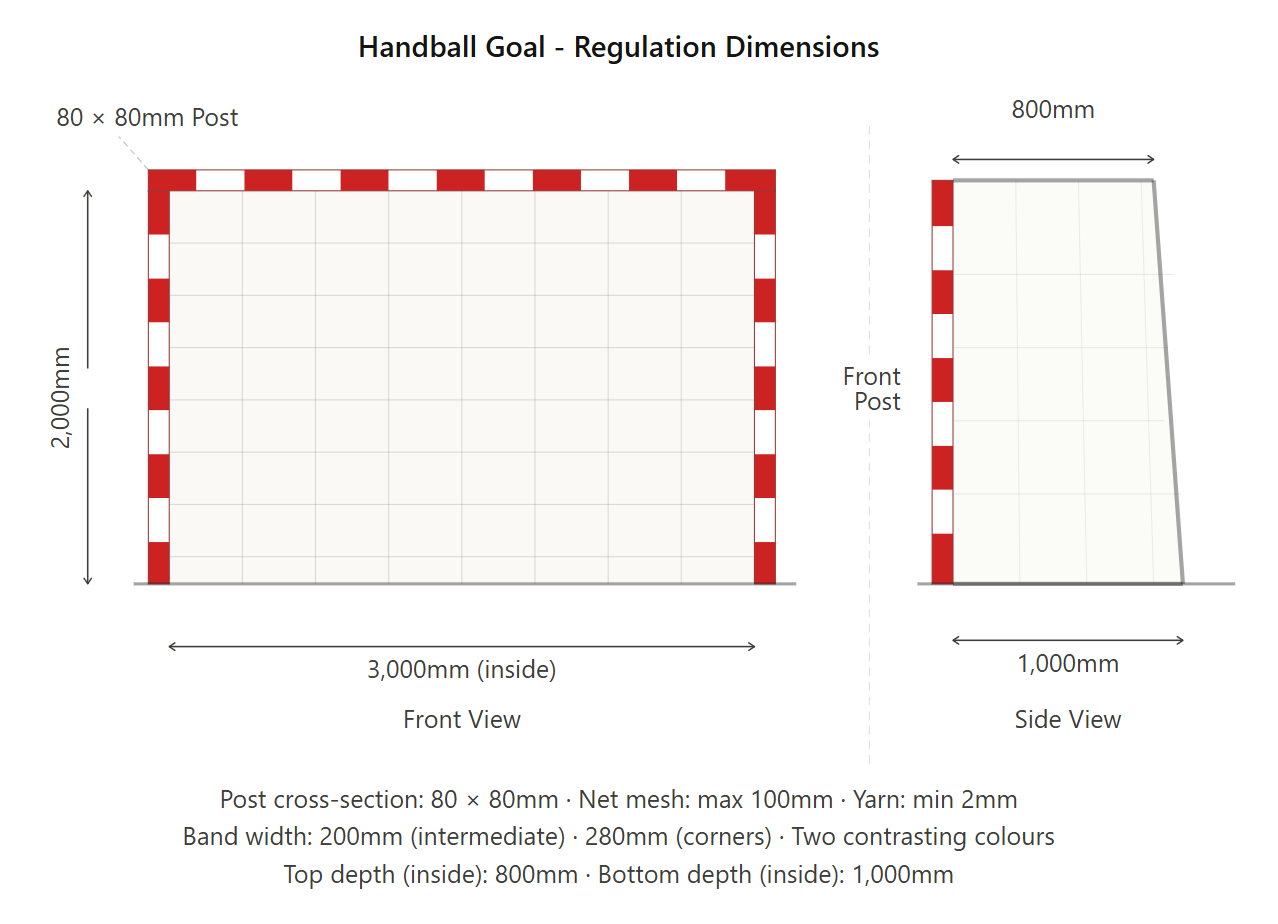
Handball regulations are very comprehensive, but the key points to remember are as follows:
Regulation handball goals measure 3m wide (between the inner edges of each upright) and 2m high (floor to the underside of the crossbar), with posts and crossbar 80mm square in cross-section. The frame must be painted in two contrasting colours in bands, clearly visible against the background. This is often red and white, black and white or blue and white. Both goals must use the same colour scheme.
The regulations don't specify the material of the frame, however to meet regulation requirements, the frame would need to pass load tests that assess the structural strength of the goal. We only offer aluminium and steel goals. Aluminium is the ideal choice due to its strength, natural corrosion resistance and lightweight. Steel options are cheaper, but do carry additional weight.
Nets must have a mesh width that doesn't exceed 100mm, and the yarn diameter must be at least 2mm.
Why are Handball goals striped?
The IHF rules state that goal posts and crossbar must be painted in bands of two colours which contrast clearly with each other and with the background. The practical reason is simply visibility - players, referees, and goalkeepers need to clearly judge the position of the frame at speed during a fast-paced game.
A regulation handball goal should have 200mm wide bands across the crossbar and posts, with 280mm wide band in the corners. While red and white, or blue and white are the most common combinations, any two contrasting colours are technically permitted. The goals at either end of the playing court must use the same colour scheme.
Safety & Anchoring Requirements
Handball goals must be secured when in use or in storage to prevent toppling.
Ideally, goals should be securely anchored to the wall or floor using chains if anchoring points are available. Wall or floor anchoring is usually the safest and easiest method and should be used wherever possible. We offer a range of sports hall goal anchoring solutions.
Alternatively, anchorage can be achieved using ‘Handbag’ Counterweights (see ANC-005). The manufacturer recommends 10 per goal for Aluminium Competition Handball Goals (HAN-010) and 14 per goal for Steel Handball Goals (HAN-003).